Seminars / Lectures
New Report by IITM Scientists
General Document on Common Questions and Answers on Cloud Seeding

MoES-IITM High Resolution Global Forecast Model

REAL TIME FORECAST
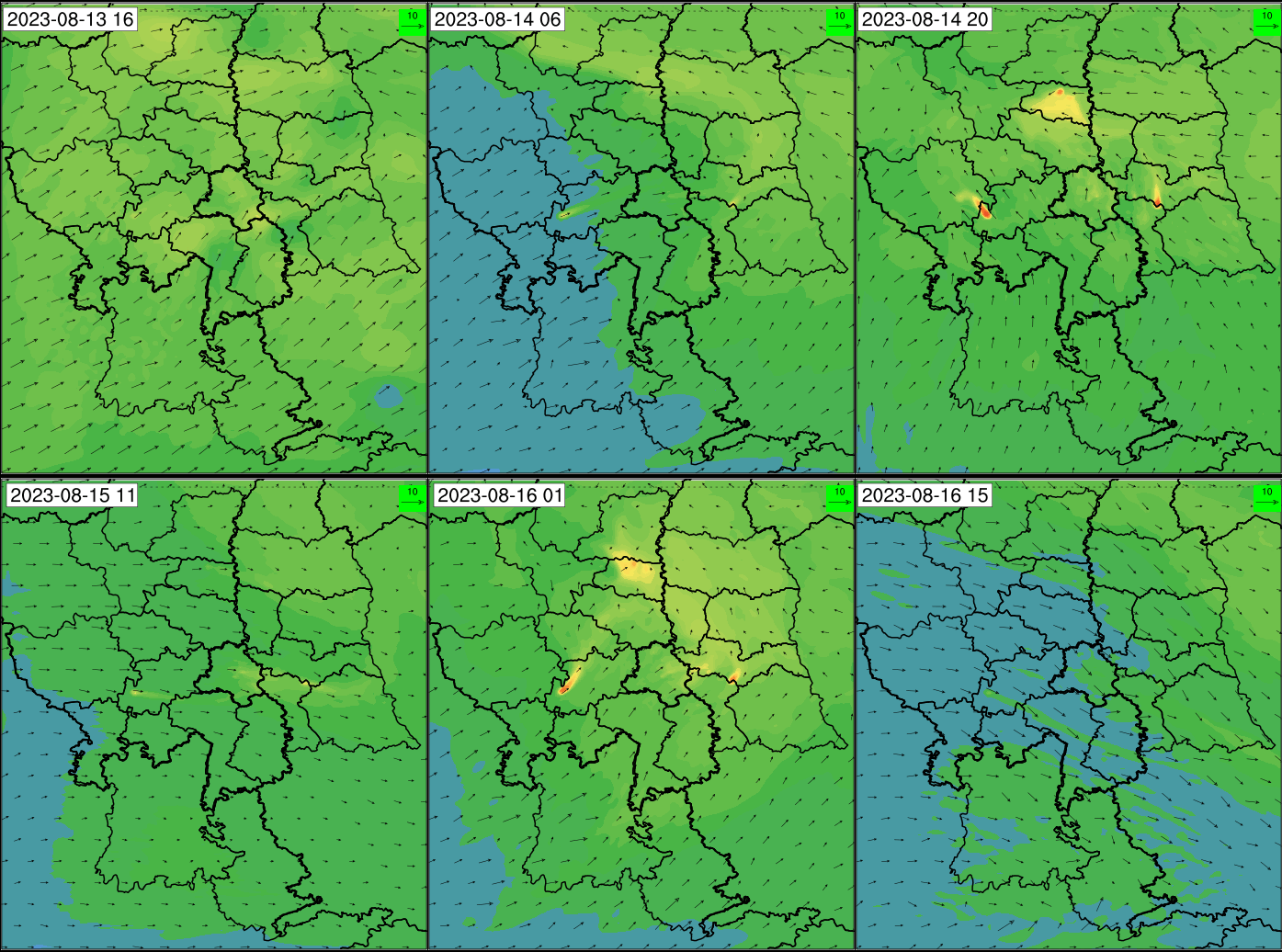
High resolution air quality forecast at 400 meter over Delhi
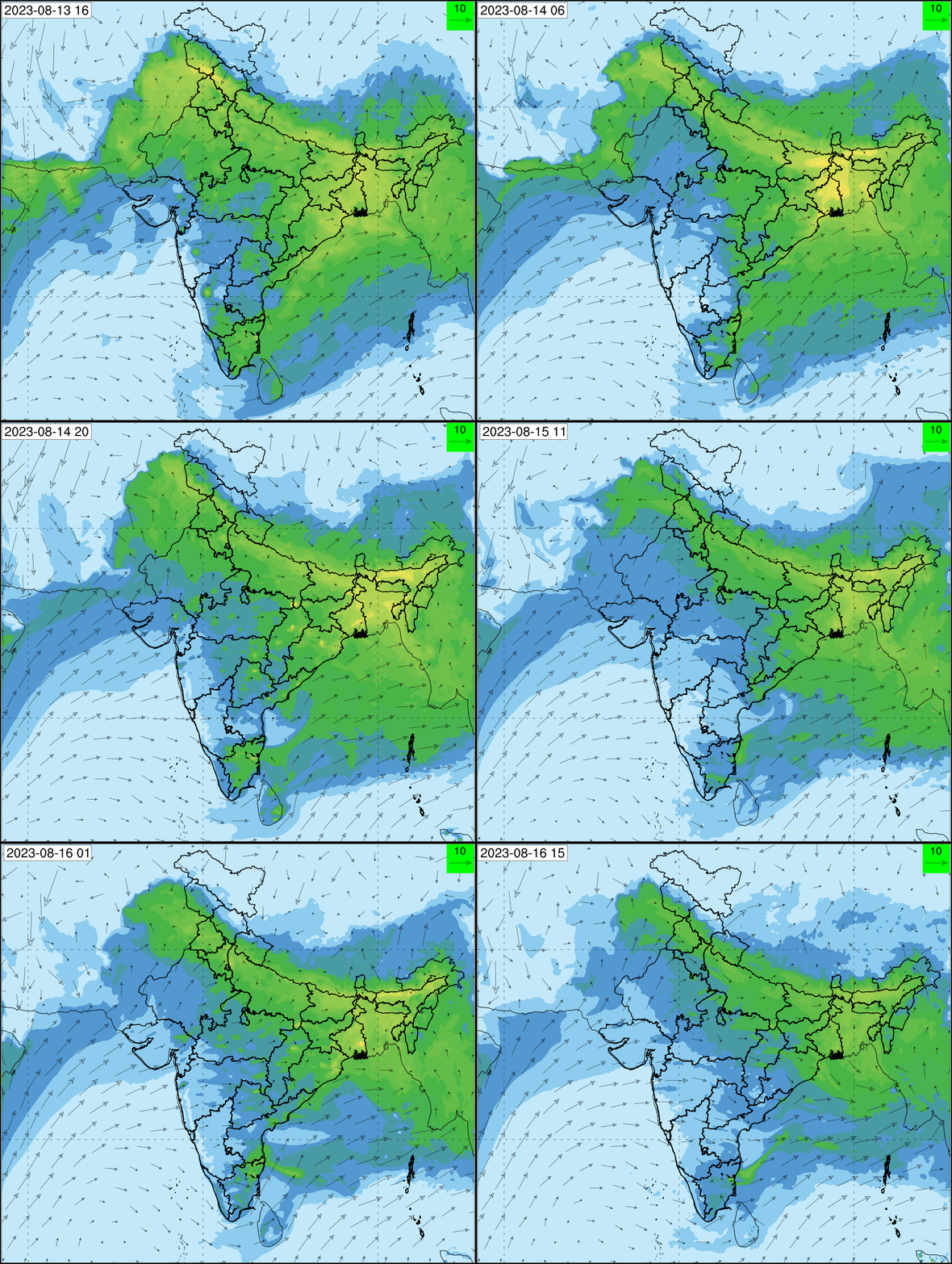
Air quality forecast at 10 km over India
IITM Publication Highlights
Comparison of Two-Moment and Three-Moment Bulk Microphysics Schemes in Thunderstorm Simulations over Indian Subcontinent
 This study focuses on three specific lightning events to conduct a sensitivity analysis, aiming to understand the differences in simulating hydrometeors between double and triple moment microphysics schemes. Lightning simulation in a model crucially depends on two factors: dynamics and cloud microphysics. Three thunderstorm cases are simulated using NTU-3 M and Morrison-2 M bulk microphysics schemes. NTU-3 M microphysics scheme produced better storm characteristics, such as rainfall, lightning as compared to the Morrison-2 M scheme. Difference in simulation outcomes is attributed to variations in particle size, density, and fall speed between the microphysical schemes.
Mallick C., Dutta U., Bhowmik M., Mohan G.M., Hazra A., Ghosh R., Pawar S.D., Chen J.P., Atmospheric Research, 310: 107614, November 2024, DOI:10.1016/j.atmosres.2024.107614, 1-19
Read MoreIntensification mechanisms and moisture dynamics of super cyclonic storm ‘Amphan’ over the Bay of Bengal: Implications for aerosol re-distribution
 The study research (This study) investigates the dynamics and underlying causes contributing to the exceptional intensity of Super Cyclonic Storm (SuCS) Amphan (16th to 21st May 2020) over the Bay of Bengal (BoB), as well as its impact on aerosol redistribution along the four cities of eastern coast and north-eastern India. The study found that the evolution of ’barrier layer thickness’(BLT) leading up to landfall, noting a thickening trend from 8 to 3 days before landfall. A mean positive SST anomaly of 0.8 to 1 ◦C was observed ’before’ the cyclone period (10-15 May 2020) near the cyclogenesis point, which set the stage for the cyclogenesis and further rapid intensification of SuCS Amphan. Presence of high-altitude clouds in SuCS Amphan, composed primarily of ice crystals. Transports of Sea-salt and PM2.5 aerosols from the ocean to the landfall region. Transports of Sea-salt and PM2.5 aerosols from the ocean to the landfall region.
Singh Vivek, Srivastava Atul K., Gupta A., Konduru R.T., Singh A., Singh S., Kumar Arun, Bisht D.S., Singh A.K., Science of The Total Environment, 951: 175501, November 2024, DOI:10.1016/j.scitotenv.2024.175501, 1-19
Read MoreMadden Julian Oscillation moves faster as the meridional moisture gradient intensifies in a warming world
 The Madden-Julian Oscillation (MJO) accounts for over 55% of weather variability in the tropics. The study reveals that the MJO is moving faster in a changing climate. A significant increase in MJO phase speed is observed — during the 20th century: 0.6–1.2 m/s per century and 21st century: 0.3–1.5 m/s per century. This increase is accompanied by multidecadal fluctuations. The overall increase in phase speed is attributed to global warming, which intensifies the meridional moisture gradient around the Indo-Pacific warm pool. Meanwhile, multidecadal variability in MJO speed is linked to changes in the zonal moisture gradient driven by the Pacific Decadal Oscillation (PDO).
Dasgupta P., Roxy M.K., Nam S., Prajeesh A.G., Saranya J.S., Zhang C., Ling J., Kim D., Geophysical Research Letters, 51: e2024GL110461, October 2024, DOI:10.1029/2024GL110461, 1-11
Read MoreDimethyl sulfide (DMS) climatologies, fluxes, and trends – Part 1: Differences between seawater DMS estimations
Dimethyl sulfide (DMS) climatologies, fluxes, and trends – Part 2: Sea–air fluxes
 In most atmospheric models, the impact of ocean-atmosphere emissions of dimethyl sulfide (DMS) on the Earth’s radiative budget depends on global distributions of seawater DMS concentrations and sea–air flux parameterizations. In both the papers, a comparison of seawater DMS climatologies and the resultant sea-air fluxes was studied. Large differences, often more than 100 %, are observed between the currently available seawater DMS climatologies. The uncertainty in DMS fluxes is driven by the uncertainty in seawater DMS concentrations in most regions but by the choice of flux parameterization in others. The results show increasing trends for seawater DMS concentrations and DMS fluxes, but there is significant uncertainty in both.
Joge S.D., Mahajan A.S., Hulswar S., Marandino C.A., Galí M., … et al., Biogeosciences, 21, October 2024
Read More: Part 1 Read More: Part 2Empirical orthogonal function analysis of lightning flashes over India
 A widely used statistical technique, EOF analysis has been used to study the spatial and temporal modes of lightning flash rate density over India. Empirical orthogonal function (EOF) analysis serves as a fundamental tool providing for a clear understanding of large-scale patterns. First three orthogonally independent modes are considered in order to retrieve the maximum variance of lightning explained by each mode. Positive correlation of IOD and BOB meridional SST gradient with first mode, suggests l role of Indian Ocean in the typical lightning flashes over India.
Prasanna K., Gopalakrishnan V., Biswasharma Rupraj, Pawar S.D., Journal of Atmospheric and Solar Terrestrial Physics, 262: 106311, September 2024, DOI:10.1016/j.jastp.2024.106311, 1-13
Read MoreNew Publications

Vertical Profiles of Black Carbon and Associated Radiative Properties over India: Inter-comparison of Measured and Reanalysis Data
Soni A., Soyam P.S., Konwar M., Malap N., Safai P., Prabhakaran Thara, Journal of Atmospheric and Solar-Terrestrial Physics, 265: 106358, 2024, December 2024, DOI:10.1016/j.jastp.2024.106358, 1-9

Greenhouse warming-induced changes in Indian summer monsoon-ENSO teleconnections as modulated by the North Tropical Atlantic
Aswale A.M., Sooraj K.P., Terray P., Swapna P., Climate Dynamics, 62, November 2024, DOI:10.1007/s00382-024-07454-1, 10325-10346

The extreme monsoon climate and associated ancient communities, kingdoms, irrigational advancement in Deccan India during the late Holocene
Reddy A.P., Gandhi N., Challa S.K., Jangari N., Shen C., Regional Environmental Change, 24: 169, November 2024, DOI:10.1007/s10113-024-02323-3, 1-13

Wintertime source apportionment of PM2.5 pollution in million plus population cities of India using WRF-Chem simulation
Jat R., Gurjar B.R., Ghude S.D., Yadav P., Modeling Earth Systems and Environment, 10, October 2024, DOI:10.1007/s40808-024-02119-8, 6065-6082
IITM Events
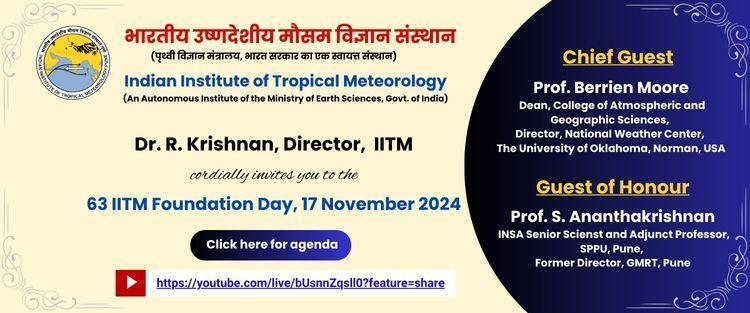
IITM Foundation Day
(17 November 2024)
IITM celebrated its 63rd Foundation Day on November 17, 2024. Prof. Berrien Moore, Dean, College of Atmospheric and Geographic Sciences, Director, National Weather Center, The University of Oklahoma, Norman, USA, and Prof. S. Ananthakrishnan, INSA Senior Scientist and Adjunct Professor, SPPU, Pune, Former Director, GMRT, Pune were the Chief Guest and the Guest of Honor of the function respectively. The celebration included distinguished lectures, an awards ceremony and recognition of IITM’s commitment to scientific excellence. A cultural program was also organized at the end of the day.
Read More Photo Gallery Agenda Youtube Streaming Cultural Program Flyer
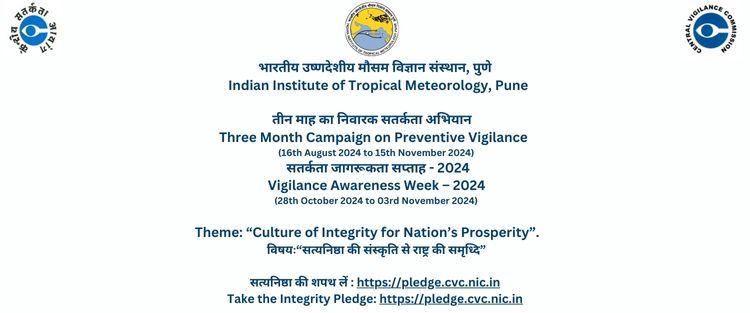
Vigilance Awareness 2024
(28 October to 03 November)
IITM observed Vigilance Awareness Week with the theme “Culture of Integrity for Nation’s Prosperity”. Throughout the week, various competitions were organized. Several talks and seminars were organized as part of capacity building and as a precursor to Vigilance Awareness Week.
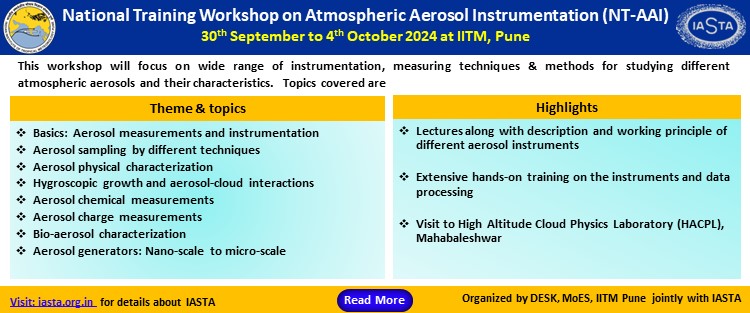
National Training Workshop on “Atmospheric Aerosol Instrumentation” (NT-AAI)
(30 September to 04 October 2024)
DESK, IITM organized the workshop in collaboration with Indian Aerosol Science & Technology Association (IASTA). The workshop focused on wide range of instrumentation and measuring techniques for studying different atmospheric aerosols and their characteristics.
Swachhata Hi Seva Campaign & Blood Donation Day
(17 September – 02 October 2024, 01 October 2024)
Outreach activities viz. cleanliness drive, free health check-up camp, plantation drive, scrap disposal and plastic collection drive, distribution of plant saplings and essential medicines were conducted.
As part of Blood Donation Day, IITM employees took Blood donation pledge and blood donation camp was arranged by Jankalyan Raktpedhi, Pune at IITM, Pune.