Seminars / Lectures

New Report by IITM Scientists
General Document on Common Questions and Answers on Cloud Seeding

MoES-IITM High Resolution Global Forecast Model

REAL TIME FORECAST
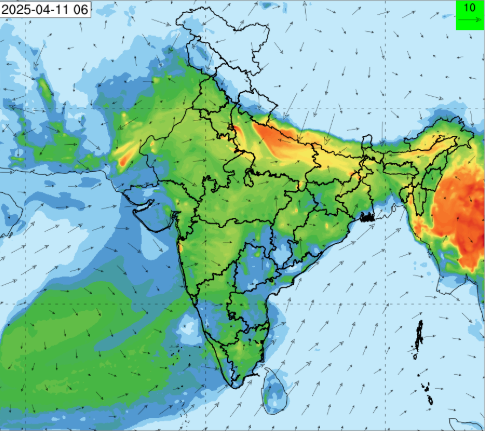
High resolution air quality forecast at 400 meter over Delhi

Air quality forecast at 10 km over India
IITM Publication Highlights
Influence of ground-based microwave radiometer profile assimilation on fog genesis forecasts in the winter boundary layer of Northern India
 This study leveraged key observations from the initiatives of IITM’s WiFEX group to enhance fog forecasting over northern India using advanced data assimilation techniques. By incorporating detailed temperature and humidity profiles from ground-based microwave radiometers, along with high-resolution soil moisture data, the research improved simulations of fog formation—particularly over the Delhi region. The integration of these atmospheric and land surface datasets significantly enhanced forecast accuracy, reducing errors and improving the spatial representation of fog coverage.
(Parde A.N., Ghude S.D., Prasad V.S., Hari Prasad K.B.R.R., Dhangar N.G., Lonkar P., Jenamani R.K., Biswas M., Wagh S., Chen F., Rajeevan M., Journal of Geophysical Research: Atmospheres, 130: e2024JD042224, May 2025, DOI:10.1029/2024JD042224, 1-25)
Read MoreArctic sea-ice decline causes intense summer monsoon precipitation events over South Asia under greenhouse warming
 This study investigates the polar teleconnection to intense summer monsoon precipitation over South Asia. Arctic sea-ice decline has been accelerating in response to anthropogenic warming. In this study, observational data and simulations from the Indian Institute of Tropical Meteorology Earth System Model (IITM-ESM) are used to examine the influence of Arctic sea-ice loss on tropical precipitation, with a particular focus on intense summer monsoon events over South Asia. The enhanced Arctic sea-ice melt increases mid-latitude atmospheric waviness, intensifies the circumglobal teleconnection-like pattern, and strengthens the subtropical high over East Asia. This, together with a La Niña-like response in the Pacific, enhances mean summer monsoon precipitation over South Asia. Additionally, the enhanced tropical energy and anomalous mid-latitude intrusions resulting from Arctic sea-ice melt create a favorable environment for moisture convergence and intense summer monsoon precipitation events. These findings suggest that in a warming climate, Arctic sea-ice melt is likely to be a key driver of intensified mean and extreme summer monsoon precipitation over the South Asian region.
(Sandeep N., Swapna P., Krishnan R., Mujumdar M., Samanta S., Ravichandran M., Environmental Research Letters, 20: 054073, May 2025, DOI:10.1088/1748-9326/add0ca, 1-15)
Read MoreMechanism driving stronger tropical cyclones in cooler autumn than the hottest summer
 This study reveals an interesting aspect of tropical cyclones in the western North Pacific: they tend to be stronger during the cooler autumn months than in the warmer summer. While this may seem counterintuitive due to declining sea surface temperatures (SSTs) in autumn, several oceanic and atmospheric factors contribute to this phenomenon. In autumn, the ocean’s mixed layer deepens and subsurface heat content increases, providing more stored energy to fuel cyclone intensification and reducing storm-induced SST cooling. Additionally, atmospheric thermodynamic conditions become more conducive to TC intensification in autumn, with enhanced latent and sensible heat fluxes driven by greater air–sea temperature and moisture differences. Another contributing factor is that autumn typhoons tend to track closer to the equator, where oceanic conditions are more favorable for intensification. These findings offer valuable insight into seasonal variations in typhoon strength and can contribute to improved seasonal forecasting and disaster preparedness.
(Singh Vineet K., Kim H.J., Moon I.J., npj Climate and Atmospheric Science, 8: 132, March 2025, DOI:10.1038/s41612-025-01008-w, 1-14)
Read MoreDeep Waters a Significant Source of Black Carbon Aerosols in the Arabian Sea
 This multidisciplinary study by CAIPEEX scientists from Indian Institute of Tropical Meteorology (IITM) Pune discovered that Black Carbon (BC) aerosols—tiny, light-absorbing particles—were previously thought to end up in the ocean through scavenging. However, this study shows that under certain conditions, such as cyclone-driven vertical mixing, they can be ejected back into the atmosphere along with sea spray. This finding is the first of its kind and is supported by a combination of real-time observations, satellite data, reanalysis data, and computer models. The research was conducted during the EKAMSAT (Enhancing Knowledge of the Arabian Sea Marine Environment through Science and Advanced Training) cruise campaign in 2023 over the Arabian Sea, a collaboration between the Ministry of Earth Sciences (MoES) and USA scientists. Further analysis revealed that deep-water vertical mixing plays a key role in bringing Black Carbon (BC) from ocean depths to the surface. The deep ocean, being one of the largest reservoirs of BC aerosols, was found to significantly contribute to the observed high BC concentrations. These findings highlight the need for controlled simulation experiments and reduce uncertainties about atmospheric aerosols globally and could lead to better strategies for combating climate change.
(Soni A., Soyam P.S., Bankar S., Prabhakaran T., Fernando H.J.S., Gamage D., Modjeski G., Bolella S., Goes J., Kovach C., Bera S., Arvindhavel A., Zaffoli M.L., Tandon A., Konwar M., Murugavel P., Safai P., Decessari S., Facchini M.C., Lee C.M., Kalarikkal N., Environmental Research Letters, 20: 054049, April 2025, DOI:10.1088/1748-9326/adc751, 1–11)
Read MoreNew Publications

Lower atmospheric profiling for climate studies pertaining to aerosols, radiation and turbulence using Unmanned Aerial System in India: Initial results
(Padmakumari B., Kalgutkar S., Nikam M., Mukherjee S., Atmospheric Environment, 351: 121211, June 2025, DOI:10.1016/j.atmosenv.2025.121211, 1-16)

Falling trend of winter lightning over western India and its possible relation with western disturbances
(Gangane A., Priyadarshini P., Pawar S.D., Syed H.A., Biswasharma R., Gopalakrishnan V., Lal D.M., Earth and Space Science, 12: e2024EA003726, April 2025, doi.org/10.1029/2024EA003726, 1-19)

Atmospheric drivers of post-monsoon and winter thunderstorms in Central India
(Murali Krishna U.V., Das Subrata K., Victor J.N., Science of The Total Environment, 979: 179432, June 2025, DOI:10.1016/j.scitotenv.2025.179432, 1-13)

Potential role of Southern Annular Mode and Atlantic Ocean on West African summer monsoon rainfall
(Prabhu A., Arya S., Climate Dynamics, 63: 174, March 2025, DOI:10.1007/s00382-025-07664-1, 1-19)
IITM Events

Collaborative Workshop jointly organized by IITM and RBI
(23 April 2025)
The Collaborative Workshop on Climate Data and Climate Model Familiarization for Financial Applications was held on 23rd April 2025 at IITM Pune, jointly organized by IITM and RBI. The workshop highlighted IITM’s climate modeling capabilities and RBI’s use of climate data in finance, concluding with a mutual agreement to strengthen future collaboration between the institutions.
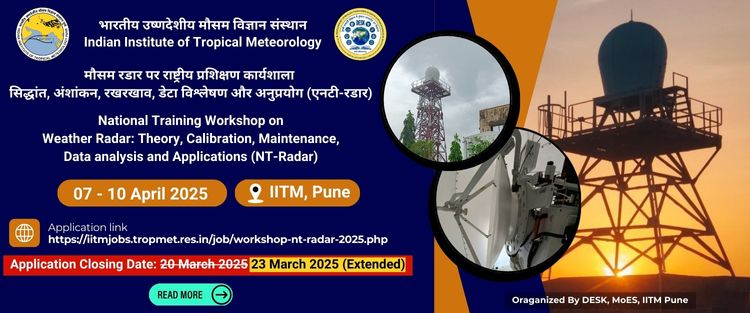
National Training Workshop on Weather Radar (NT-Radar)
(07-10 April 2025)
The NT-Radar workshop, conducted from 07–10 April 2025 at IITM Pune, focused on weather radar theory, calibration, maintenance, data analysis, and applications. Key topics included Doppler radar fundamentals, AI/ML-based nowcasting, dual-polarization techniques, and radar-NWP model integration. Organized by DESK, MoES, IITM, it aimed to build technical capacity in radar meteorology.
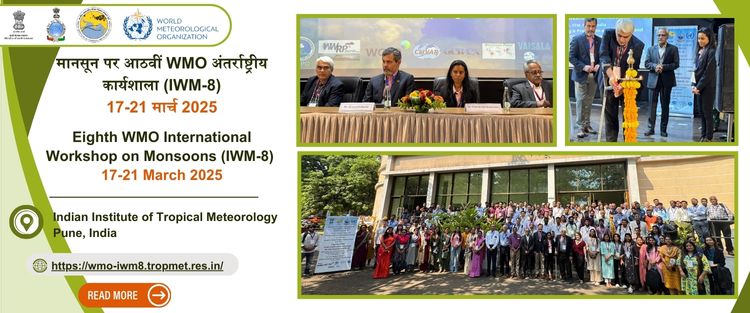
Eighth WMO International Workshop on Monsoons (IWM-8)
(17-21 March 2025)
IWM-8, the eighth workshop series under the World Weather Research Programme (WWRP) of the World Meteorological Organization (WMO) organized at IITM, Pune in hybrid mode. The workshop aimed to explore recent advances in monsoon prediction, modeling, and understanding, including new tools for forecasting extreme rainfall and their societal benefits.
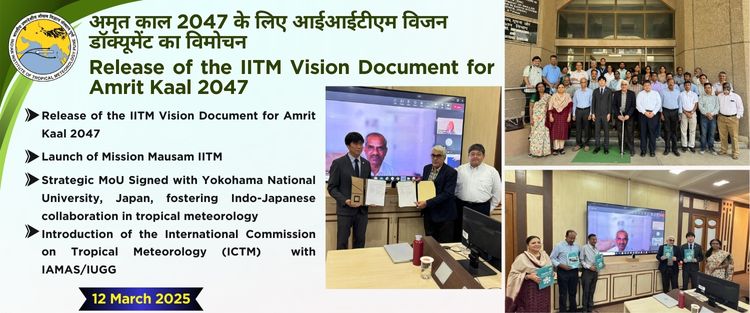
Transforming Tropical Meteorology: Landmark Initiatives
(12 March 2025)
A series of high-impact events were hosted at IITM Pune, marking significant advancements in tropical meteorology, climate research, and global scientific collaboration.