Seminars / Lectures

New Report by IITM Scientists
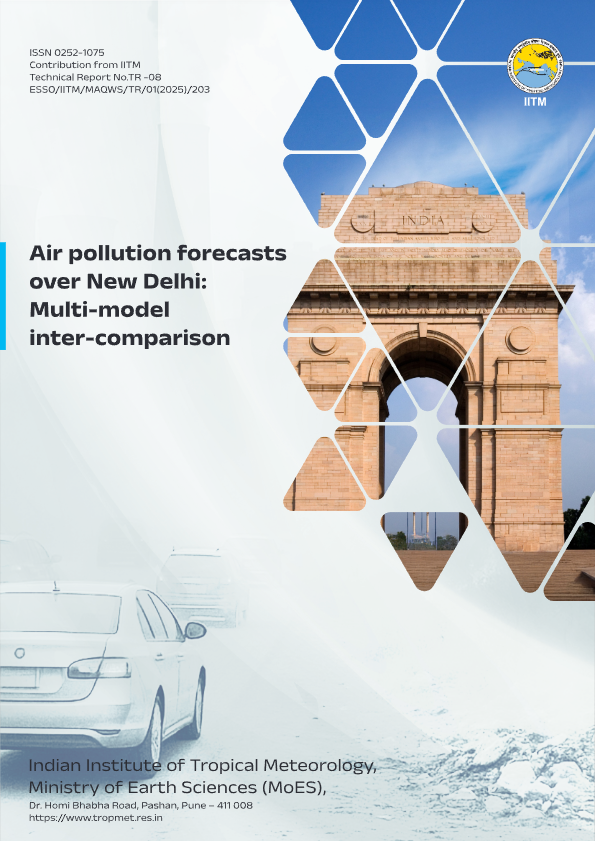
MoES-IITM High Resolution Global Forecast Model

REAL TIME FORECAST
High resolution air quality forecast at 400 meter over Delhi

Air quality forecast at 10 km over India

IITM Publication Highlights

Influence of nitrogen oxides and volatile organic compounds emission changes on tropospheric ozone variability, trends and radiative effect
The study highlights the dominant role of anthropogenic NOx emissions in driving tropospheric ozone trends, photochemical regimes, and radiative forcing over the past two decades. Changes in NOx emissions exert a stronger influence on ozone levels and radiative forcing than VOCs, with many regions shifting from VOC-limited to NOx-limited regimes as NOx reductions progress. The findings emphasize the need for region-specific mitigation strategies to effectively address ozone pollution.
Fadnavis S., Elshorbany Y., Ziemke J., Barret B., Rap A., Chandran P.R.S., Pope R.J., Sagar V., Taraborrelli D., … et al., Atmospheric Chemistry and Physics, 25, July 2025, DOI:10.5194/acp-25-8229-2025, 8229-8254
Read More
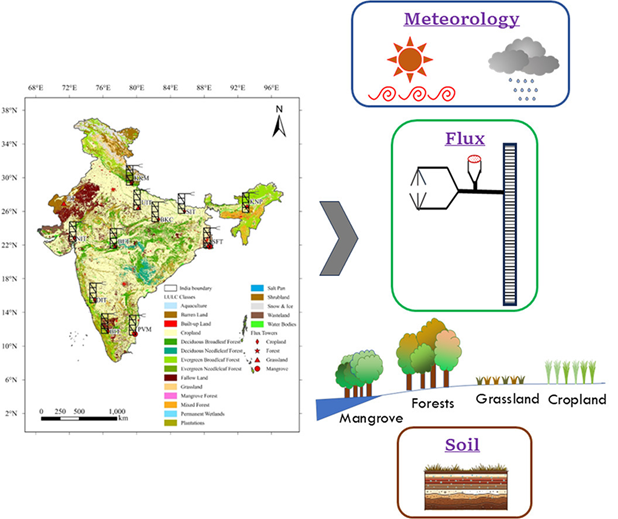
Ecosystem-atmosphere exchanges of carbon dioxide, water vapour and energy in India: A synthesis of insights from eddy covariance measurements
The study compiles flux observations from diverse Indian ecosystems, including forests, grasslands, croplands, and mangroves, presenting the first comprehensive synthesis of ecosystem–atmosphere exchanges across South Asia. It underscores the urgent need to expand India’s terrestrial monitoring network, with significant implications for climate mitigation and adaptation policies. Strengthening this network will enhance estimates of the terrestrial carbon cycle in India and South Asia, while supporting improvements in weather forecasting and ecosystem modeling.
Deb Burman P.K., Bhat G.S., Tiwari Y.K., Morrison R., …, Sarma Dipankar, … et al., Agricultural and Forest Meteorology, 372: 110730, September 2025, DOI:10.1016/j.agrformet.2025.110730, 1-20
Read More
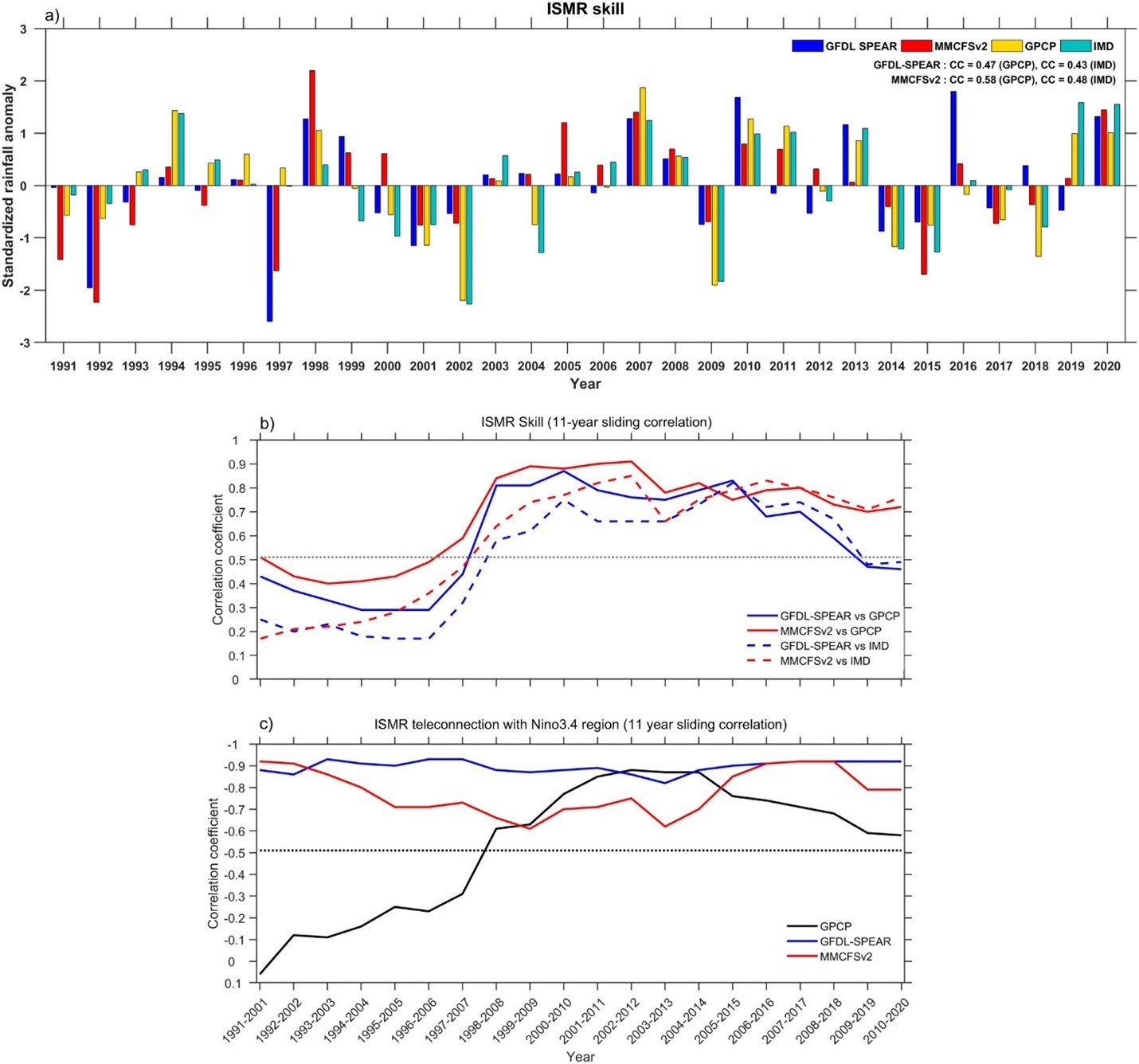
Assessment of Indian Summer Monsoon in Seasonal Hindcasts From Next-Generation GFDL and IITM Models
The study evaluates two next-generation seasonal prediction systems—GFDL-SPEAR (Geophysical Fluid Dynamics Laboratory–Seamless System for Prediction and Earth System Research) and MMCFSv2 (Monsoon Mission Coupled Forecast System, version 2)—both of which feature updated model physics and enhanced dynamical cores. The process-level insights derived from this evaluation contribute to advancing the development of robust seasonal prediction systems and strengthening climate services across South Asia.
Suneeth, K. V., P. A. Pillai, S. A. Rao, D. Jain, M. Pradhan, and A. Srivastava., International Journal of Climatology, Online, August 2025, DOI:10.1002/joc.70068
Read More
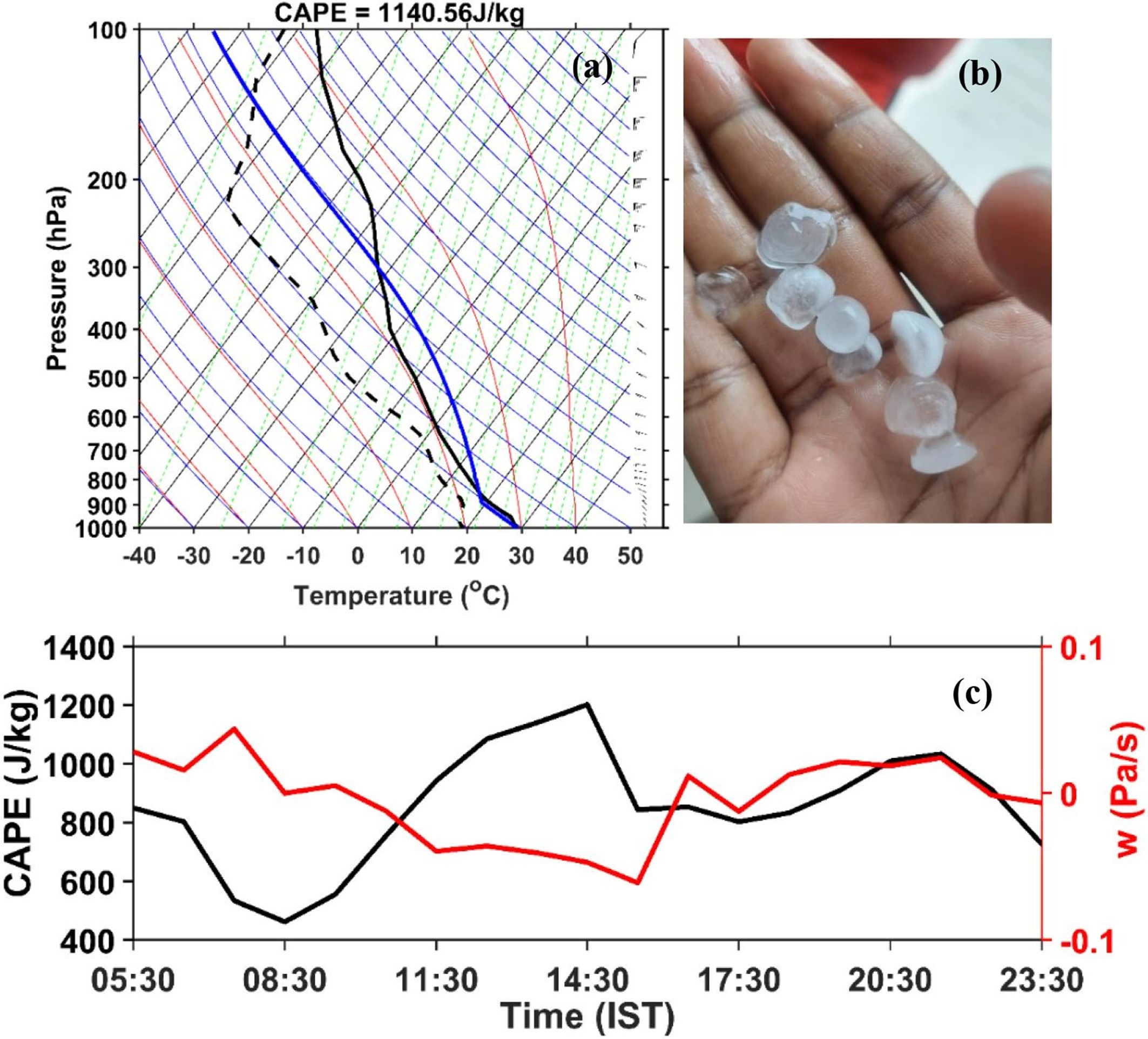
Polarimetric insights into pre-monsoon convective clouds and hail storm microphysics over central India using polarimetric radar observation
The study reports the first observation of hailstorm events over the monsoon core zone in central India using C-band dual-polarization radar at IITM’s ART facility, Silkheda. It presents a detailed microphysical analysis of hailstorm events and pre-monsoon convective cloud systems, revealing that these clouds are predominantly characterized by riming and accretion processes leading to dry hail and graupel formation above the melting layer.
Abhijeet K., Deshpande S.M., Pandithurai G., Atmospheric Research, Online, July 2025,.2025.108381, DOI:10.1016/j.atmosres, 1-15
Read More
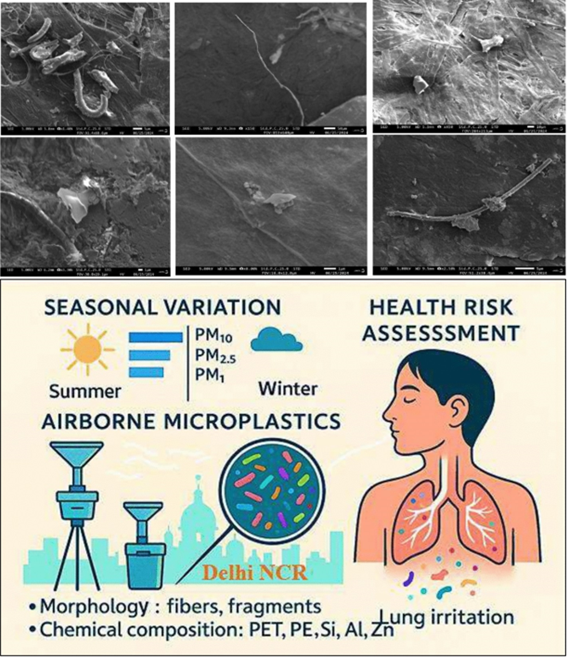
Characterization and health risk assessment of airborne microplastics in Delhi NCR
This study provides the first comprehensive assessment of airborne microplastics (MPs) in Delhi, analyzing their seasonal distribution, morphology, chemical composition, and potential health impacts. Measured concentrations were 1.87 MPs/m³ (PM₁₀), 0.51 MPs/m³ (PM₂.₅), and 0.49 MPs/m³ (PM₁), with significant seasonal variation. Fragments and fibers dominated, primarily composed of polyethylene terephthalate (PET) and polyethylene (PE), along with trace elements such as zinc, silicon, and aluminium. Wind analysis indicated transport from the northwest, emphasizing regional source influence. The findings highlight potential inhalation-related risks and underscore the need to integrate MPs into air quality frameworks and initiate long-term monitoring.
Rao, M. N., Ghude, S. D., Nivdange, S. S., Panchang, R., Pipal, A. S., Mukherjee, A., Sharma, H., & Kumar, V., Scientific Reports, 15(1), 1–15. , DOI: 10.1038/s41598-025-04306-8
Read MoreNew Publications

Indicators of sustained agriculture, impacts of LULC and weather parameters on ET: Case study in Chota Nagpur Plateau
Murmu J., Latha R., Pande C., Bandaru M., Kumar M., Environmental and Sustainability Indicators, 27, August 2025, DOI:10.1016/j.indic.2025.100836, 100836

Advancing the Understanding and Prediction of Monsoons and Their Impacts in a Changing Climate
Rajagopal, E. N., Krishnan, R., Ingle, S., Luo, Y., Wang, Z., Caltabiano, N., Palanisamy, H., Li, L., & Xue, L., Bulletin of the American Meteorological Society, 106(7), July 2025, DOI:10.1175/BAMS-D-25-0161.1, E1439–E1444

The role of dust aerosols in increasing positive cloud to ground lightning activity over Western India (Maharashtra)
Gangane, A., Pawar, S. D., Varikoden, H., Gopalakrishnan, V., & Lal, D. M., Atmospheric Environment, 360, July 2025, DOI:10.1016/j.atmosenv.2025.121420

Comprehending the Synergistic Roles of Cloud Properties and Dynamics on Extreme Rainfall Events During the Indian Summer Monsoon of 2019
Arya, V. B., Bhowmik, M., Hazra, A., Rao, S. A., Jain, D., Maurya, R. K. S., & Kiran, V. G. , International Journal of Climatology, Online, July 2025, DOI:10.1002/joc.70044, e70044
IITM Events

Akshay Urja Diwas
(20 August 2025)
On 20 August 2025, IITM Pune observed Indian Akshay Urja Day under the Environmental Information, Awareness, Capacity Building and Livelihood Programme (EIACP), MoEFCC. Prof. Chetan Singh Solanki, Founder, Energy Swaraj Foundation and Professor at IIT Bombay, delivered a thought-provoking lecture on “On a finite planet, can we have ever-growing consumption?”, emphasizing the need for sustainable energy practices and mindful resource use.

Independence Day
(15 August 2025)
IITM Pune celebrated Independence Day 2025 with an inspiring address by Dr. A. Suryachandra Rao, Director, IITM. In his message, Dr. Rao highlighted the institute’s significant contributions to advancing the scientific understanding of the atmosphere and climate through cutting-edge research, reaffirming IITM’s role in shaping climate science for the nation and beyond.

First Urban Testbed Established in Chennai
(15 August 2025)
The Ministry of Earth Sciences (MoES) has set up the first Urban Testbed site under Mission Mausam at Sathyabama Institute of Science and Technology (SIST), Chennai. A state-of-the-art Ceilometer with depolarization capability was inaugurated on 15 August 2025, enabling continuous monitoring of aerosols and clouds with high accuracy under all weather conditions.

A Decade of WiFEX & New IITM Initiatives
(22 July 2025)
IITM marked significant milestones with the 10-year completion of WiFEX (Winter Fog Experiment), the inauguration of a state-of-the-art Atmospheric Chemistry Laboratory, and the launch of the MoES Early Career Researchers Hub for Earth Sciences. The events were graced by Hon. Secretary, MoES, Dr. M. Ravichandran on 22 July 2025.