भारतीय उष्णदेशीय मौसम विज्ञान संस्थान
Indian Institute of Tropical Meteorology
पृथ्वी विज्ञान मंत्रालय, भारत सरकार का एक स्वायत्त संस्थान An Autonomous Institute of the Ministry of Earth Sciences, Govt. of India
High Altitude Cloud Physics Laboratory (HACPL)
Objectives
To understand the micro physical and dynamical processes involved in aerosol-cloud-precipitation interactions using in-situ and remote sensing measurements over a high-altitude site.
To understand the role of aerosol size, chemical constituents and hygroscopicity in cloud activation processes
To develop parameterization schemes for CCN, Ice Nuceli, warm rain processes to implement in CFS/ESM models
About Us
The most important source of systematic errors in all weather and climate prediction model is related with inaccuracy in formulation (or parameterization) of clouds. The parameterization of convection in weather and climate models depends on our understanding of how small scale clouds interact with the large scale environments and how aerosol interact with the clouds. In order to get data on cloud microphysics under different large range of meteorological conditions and distributions, it is important to continue these measurements for a reasonably long time. On the other hand, if we could set up a cloud physics and aerosol measurements observatory at a high altitude station where cloud bases touch the ground, one could make cloud-microphysics measurements together with aerosol and meteorological measurements for many years and could thereby collect data spanning different conditions. Therefore, it is proposed to accelerate the experimental infrastructure by introducing uninterrupted observations and monitoring of critical atmospheric parameters and cloud parameters regularly at a high altitude station in Maharashtra viz., Mahabaleshwar along with supporting infrastructure at the IITM campus in Pune.
The High Altitude Cloud Physics Laboratory (HACPL) originated from such a unique requirement, where clouds could be continuously monitored at a single location, where cloud base touches the ground. Observations on regular basis at the HACPL will provide continuous data for the study of cloud microphysics and interaction between clouds and aerosol and the process of precipitation and related dynamics. The impact of orography of Western Ghat on the precipitation dynamics will be addressed with continuous observations with radar at this site. The continuous and simultaneous observations at Mahabaleshwar will provide unique opportunity to study detailed interaction of the dynamics and microphysics over the region and explore the differences in their spatial characteristics. The observations will also be used along with other cloud physics observations in the physical parameterization development, testing etc and to establish cloud and precipitation climatology of the region.
Project Details
Developmental Activities:
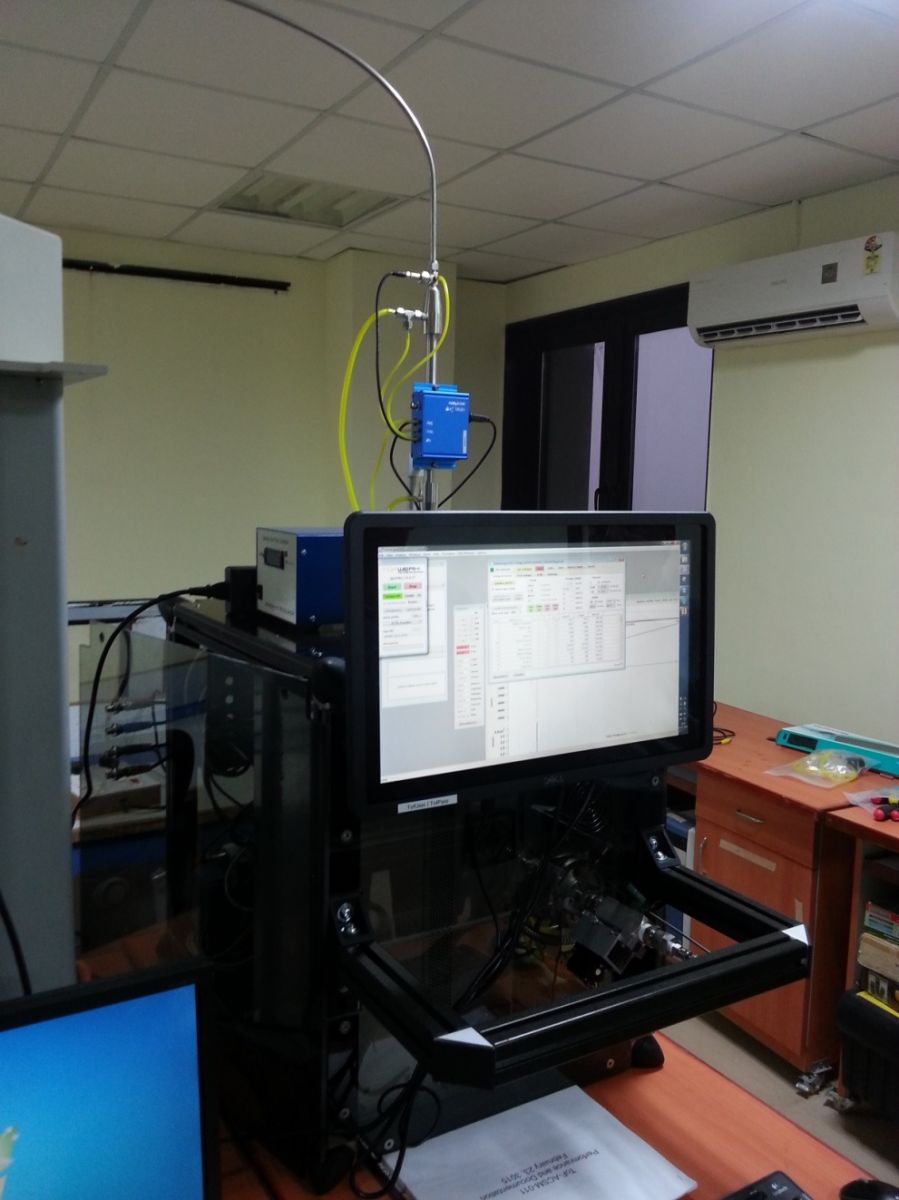
Time-of-flight (TOF) Aerosol chemical speciation monitor is installed tested and put in operation at HACPL for aerosol chemical speciation measurements. This will help in characterising the dominant chemical species in aerosol. Initial results show the dominance of organic compounds which can be source for secondary organic aerosols over this region.
Fig. : Time-of-Flight Aerosol Chemical Speciation Monitor.
Two Radiosonde soundings (3 GMT, 12 GMT) at HACPL and 1 sounding at IITM, Pune (8 GMT) were conducted during July 2015 during the CAIPEEX aircraft campaign.
For Volatile Organic Compounds (VOC) measurements, a PTRMS (Proton Transfer Reaction Mass Spectrometer) was deployed at HACPL on campaign mode (on loan from SAFAR-Pune) during June-July 2015 and data has been collected and being analysed.
Important Results:
Investigation of aerosol indirect effects on monsoon clouds using ground-based measurements over a high-altitude site in Western Ghats
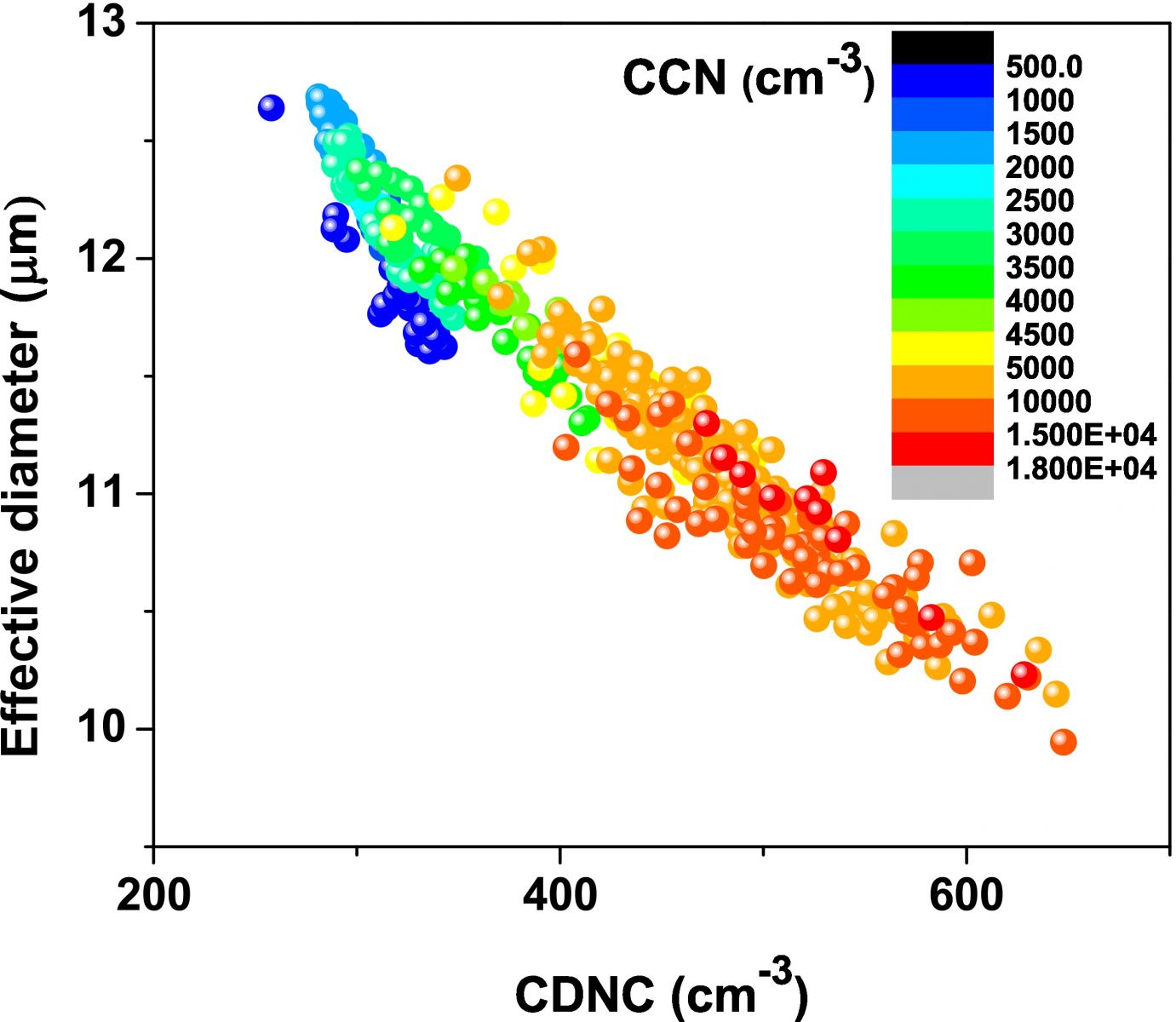
The effect of aerosols on cloud droplet number concentration and droplet effective radius is investigated from ground-based measurements over a high-altitude site where clouds pass over the surface. First aerosol indirect effect (AIE) estimates were made using (i) relative changes in cloud droplet number concentration (AIEn) and (ii) relative changes in droplet effective radius (AIEs) with relative changes in aerosol for different cloud liquid water contents (LWCs). AIE estimates from two different methods reveal that there is systematic overestimation in AIEn as compared to that of AIEs . Aerosol indirect effects (AIEn and AIEs) and dispersion effect (DE) at different LWC regimes ranging from 0.05 to 0.50 g m−3 were estimated. The analysis demonstrates that there is overestimation of AIEn as compared to AIEs , which is mainly due to DE. Aerosol effects on spectral dispersion in droplet size distribution play an important role in altering Twomey’s cooling effect and thereby changes in climate. This study shows that the higher DE in the medium LWC regime offsets the AIE by 30 %.[Anil Kumar V., Pandithurai G., Leena P. P., Dani K. K., Murugavel P., Sonbawne S. M., Patil R.D., Maheskumar R.S., Investigation of aerosol indirect effects on monsoon clouds using ground-based measurements over a high-altitude site in Western Ghats, Atmospheric Chemistry and Physics, 16, July 2016, DOI:10.5194/acp-16-8423-2016, 8423-8430]
Fig. 1: Variation of cloud microphysical parameters (droplet number concentration and effective diameter) with CCN number concentration.
Mesoscale kinematics derived from X-band Doppler radar observations of convective versus stratiform precipitation and comparison with GPS radiosonde profiles
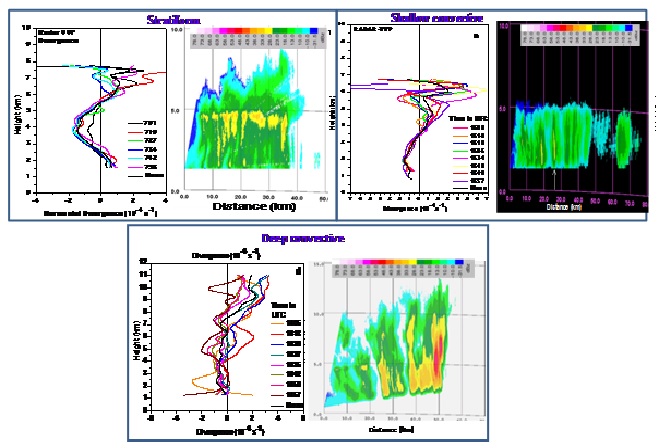
Single Doppler analysis techniques known as Velocity Azimuth Display (VAD) and Volume Velocity Processing (VVP) are used to analyse kinematics of mesoscale flow such as horizontal wind and divergence using X-band Doppler weather radar observations, for selected cases of convective, stratiform and shallow cloud systems near tropical Indian sites: Pune (18.58°N, 73.92°E, 560 m asl) and Mandhardev (18.51°N, 73.85°E, 1297 m asl). The vertical profiles of horizontal wind estimated from radar VVP/VAD methods agree well with GPS radiosonde profiles, with the Low Level Jet (LLJ) at about 1.5 km during monsoon season well depicted in both. The vertical structure and temporal variability of divergence and reflectivity profiles are indicative of the dynamical and microphysical characteristics of shallow convective, deep convective and stratiform cloud systems. In shallow convective systems, vertical development of reflectivity profiles is limited below 5 km. In deep convective systems, reflectivity values as large as 55 dBZ were observed above freezing level. The stratiform system shows the presence of a reflectivity bright band (~35 dBZ) near the melting level. The diagnosed vertical profiles of divergence in convective and stratiform systems are distinct. In shallow convective conditions, convergence was seen below 4 km with divergence above. Low-level convergence and upper level-divergence is observed in deep convective profiles, while stratiform precipitation has mid-level convergence present between lower-level and upper-level divergence. The divergence profiles in stratiform precipitation exhibit intense shallow layers of ‘melting convergence’ at 0°C level, near 4.5 km altitude, with a steep gradient on both the sides of the peak. The level of non-divergence (LND) in stratiform situations is lower than that in convective situations. These observed vertical structures of divergence are largely indicative of latent heating profiles in the atmosphere, an important ingredient of monsoon dynamics. [Deshpande S.M., Dhangar N., Das Subroto Kumar, Kalapureddy M.C.R., Chakravarty K., Sonbawne S., Konwar M., Mesoscale kinematics derived from X-band Doppler radar observations of convective versus stratiform precipitation and comparison with GPS radiosonde profiles, Journal of Geophysical Research, 120, November 2015, DOI:10.1002/2014JD022595, 11536-11551]
Fig. 2: X-band radar observations of divergence (10-4 s-1) and reflectivity (dBZ) profiles in different cloud types such as stratiform, shallow and deep convective clouds of 29 July 2012, 27 September 2012 and 11 October 2011 respectively.
Temporal and structural evolution of a tropical monsoon cloud system using X-band radar
This is a case study focusing on the horizontal and vertical structure of monsoon precipitating clouds and its temporal evolution as observed by the X-band radar. The radar reflectivity factor is used as a proxy for measure of intensity of cloud system. Result shows that the radar reflectivity has a strong temporal variation in the vertical, with a local peak occurring in the afternoon hours. Relatively shallow structure during the late night and early morning hours is noticed. The observed cloud tops reached up to 8 km heights with reflectivity maxima of about 35 dBZ at ~5 km. The spatial and vertical evolution of radar reflectivity is consistent with the large-scale monsoon circulation. The variations in the outgoing longwave radiation (OLR) from the Kalpana-1 satellite and vertical velocity and cloud-mixing ratio from the MERRA reanalysis data were also analysed. [Das S.K., Deshpande S.M., Das S.S., Konwar M., Chakravarty K., Kalapureddy M.C.R., Temporal and structural evolution of a tropical monsoon cloud system: A case study using X-band radar observations, Journal of Atmospheric and Solar Terrestrial Physics, 133, October 2015, DOI:10.1016/j.jastp.2015.08.009, 157-168]
Facilities
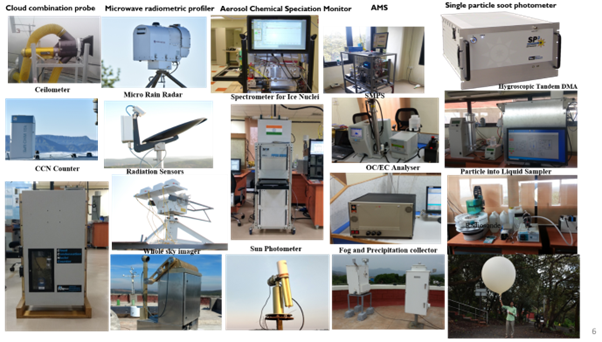
Atmospheric Research Testbed: High-Altitude Cloud Physics Laboratory
CLOUD PHYSICS
Cloud Combination Probe (CCP)
To study microphysical properties of clouds such as Droplet Size Distribution (DSD), Liquid Water Content.
Micro Rain Radar (MRR)
To study cloud density, falling rate, droplet size distribution by remote sensing up to 6 km
Whole Sky Imager (WSI)
To study macrophysical properties of clouds like cloud motion vector, cloud base temperature, cloud life time etc.
Ceilometer
To study cloud properties like cloud base height, cloud depth, cloud layers, seasonal variability of clouds etc.
Impact Disdrometer
To study raindrop size distribution, rain rate, rain intensity etc.
2D Video Disdrometer
To study raindrop size distribution, falling speed, oblateness, rain rate, rain intensity etc.
X Band RADAR
provide high-resolution, detailed views of precipitation and cloud microphysics, nowcasting, hydrometeor types and detailed storm analysis.
Sunphotometer
Measure the direct solar irradiance and sky radiance at different wavelengths.
METEOROLOGY
Automatic Weather Station
To record surface level ambient air temperature, relative humidity, atmospheric pressure, wind speed, wind direction and rain rate
Radiosonde
To record upper air temperature, relative humidity, atmospheric pressure, wind speed, wind direction profiles
Microwave Radiometric Profiler
For continuous monitoring of upper air temperature, relative humidity and liquid water profiles using remote sensing.
Ultrasonic Anemometer
For monitoring of the three wind components and air turbulence
SO2 Analyzer
Continuous monitoring of Sulphur Dioxide (SO2) gas.
Project Highlight
Seasonal variability of aerosol and CCN over HACPL
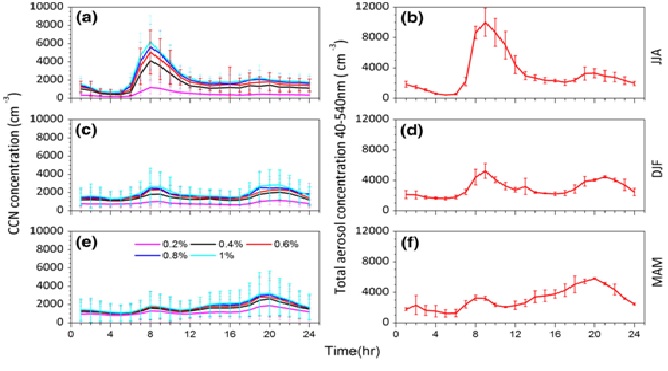
Aerosol-CCN variability and their relationship were studied for the first time at Mahabaleshwar, a high altitude (1348 m AMSL) site in the Western Ghats by using observations of one year (June 2012 to May 2013). The study was done in two sections in which first temporal variability (diurnal and seasonal) of aerosol and CCN was analysed. Later, CCN to aerosol ratio and other microphysical properties were investigated along with detailed discussion on possible sources of aerosol. Diurnal variation in aerosol and CCN concentration has shown relatively higher values during early morning hours in monsoon season, whereas in winter and pre-monsoon, it was higher in the evening hours (Fig. 1). Seasonal mean variation in aerosol and CCN (SS above 0.6%) has shown higher (less) in monsoon (winter) season. Temporal variation reveals dominance of fine-mode aerosol during monsoon season over the study region. The temporal variation of activation ratio, k-value (exponent of CCN Super-saturation spectra) and geometric mean aerosol diameter were also analysed. Variation of activation ratio was higher in monsoon, especially for SS 0.6-1%. The analysis also showed high k-value during monsoon season as compared to other seasons (Pre-monsoon and winter) which may be due to dominance of hygroscopic aerosols in the maritime air masses from the Arabian Sea and biogenic aerosol emissions from the wet forest. Analysed mean aerosol diameter is much smaller during monsoon season with less variability compared to other seasons. Overall analysis showed that aerosol and CCN concentration was higher over this high altitude site despite of dominant sink processes such as cloud scavenging and washout mechanisms indicating local emissions and biogenic Volatile Organic Compounds (BVOC) emissions from wet forest as major sources. [Leena P. P., Pandithurai G., Anilkumar V., Murugavel P., Sonbawne S.M., Dani K.K., Seasonal variability in aerosol, CCN and their relationship observed at a high altitude site in Western Ghats, Meteorology and Atmospheric Physics, Online, September 2015, DOI:10.1007/s00703-015-0406-0]
Fig. 1: Diurnal variation in CCN concentration (a, c, e) for different super saturations and total aerosol concentration 40-540 nm (b, d, f) for the period June 2012 to May 2013.
Recent Publications
2025
Radar-Derived Rainfall Distribution over the Western Ghats of India: Investigating Orography–Dynamics Interactions
Jha K Ambuj, G. S. Bhat, M. C. R. Kalapureddy, and G. Pandithurai
DOI: https://doi.org/10.1175/MWR-D-24-0144.1
Physical characterization and hygroscopicity of ambient aerosols and their role in CCN closure over Western Ghats, India
Das Arindam, P.P. Leena,Subrata Mukherjee, Mercy Varghese,V. Anilkumar, G. Pandithurai, Sachin Patil, Rohit D. Patil, Lalit Chaudhari
DOI: https://doi.org/10.1016/j.atmosres.2025.108297
Observed thermodynamical-cloud-rain characteristics during pre-monsoon precipitating events over a high-altitude site in Western Ghats, India,
Leena P.P., Resmi E.A., Mise D.J., Anilkumar V., Arun V.S., Patil R.P., Pandithurai G., Anilkumar L., Journal of Atmospheric and Solar Terrestrial Physics, 269: 106459, April 2025,
DOI: https://doi.org/10.1016/j.jastp.2025.106459
Aerosol volatility over a high-altitude site in India: Effect of semi-volatile organics
Subrata Mukherjee , Rohit D. Patil , M.Y. Aslam , G.S. Meena , V. Anil Kumar , Sachin S. Patil , Anoop S. Mahajan , Liselotte Tinel , Vinayak V. Waghamare , G. Pandithurai
DOI: https://doi.org/10.1016/j.atmosres.2024.107877
2024
Reflectivity-Rain Rate Relationship for Orographic Rainfall at Mahabaleswar Over the Indian Western Ghats
Kumar, A., Srivastava, A.K., Chakravarty, K. et al. Pure Appl. Geophys.
DOI: https://doi.org/10.1007/s00024-025-03761-8
Characteristics of new particle formation events in a mountain semi-rural location in India
JN Victor, P Buchunde, M Sebastian, Vijay P. Kanawade, Devendraa Siingh, Swapnil S. Potdar , T. Dharmaraj , Govindan Pandithurai, Subrata Mukherjee
DOI: https://doi.org/10.1016/j.atmosenv.2024.120414
A Statistical Study on Cloud Base Height Behavior and Cloud Types During Southwest Monsoon over a High-Altitude Site in Western Ghats, India
P. P. Leena, Dhwanit J. Mise, E. A. Resmi, V. Anil Kumar, K. Chakravarty, K. S. Nirmin, P. Pradeep Kumar, Rohit P. Patil & G. Pandithurai
DOI: https://doi.org/10.1007/s12524-024-01808-2
Aerosol volatility over a high-altitude site in India: Effect of semi-volatile organics
Subrata Mukherjee, Rohit D. Patil, M.Y. Aslam, G.S. Meena, V. Anil Kumar,Sachin S. Patil, Anoop S. Mahajan, Liselotte Tinel, Vinayak V. Waghmare, G. Pandithurai, Liselotte Tinel.
DOI: https://doi.org/10.1016/j.atmosres.2024.107877
Impact of a severe dust storm on aerosol properties and their radiative forcing over the Indian subcontinent during winter
Jeni N. Victor,Swapnil S. Potdar, Devendra Siingh, T. Gokul, A.K. Kamra, R.P.Singh, V. Gopalakrishnan, G. Pandithurai
DOI: https://doi.org/10.1016/j.atmosres.2024.107282
Seasonal variability of volatile organic compounds (VOCs) at a high-altitude station in the Western Ghats, India: Influence of biogenic, anthropogenic emissions and long-range transport
Subrata Mukherjee, G. Pandithurai, Vinayak Waghmare, Anoop S. Mahajan, Liselotte Tinel, M.Y. Aslam, G.S. Meena, Sachin Patil, Pallavi Buchunde, Anil Kumar
DOI: https://doi.org/10.1016/j.atmosenv.2024.120598
Measurements of raindrop size distribution using collocated X and Ka band radars in the Western Ghats
Subrata Kumar Das; Yogesh K. Kolte; U. V. Murali Krishna; Harshad S. Hanmante; Abhishek K. Jha; Sachin Deshpande
DOI: https://10.1109/LGRS.2024.3426515
Bias correction of an X-band radar reflectivity data to improve spatial rainfall estimation
Ambuj K Jha, G.S. Bhat, M C R Kalapureddy, G Pandithurai
DOI: https://doi.org/10.1007/s12040-024-02271-w
The influence of aerosol hygroscopicity on clouds and precipitation over Western Ghats, India
Avishek Ray, Moumita Bhowmik, Anupam Hazra, G. Pandithurai
DOI: https://doi.org/10.1002/qj.4654
Contrasting features of rainfall microphysics as observed over the coastal and orographic region of western ghat in the inter-seasonal time-scale
Kaustav Chakravarty, Rohit P. Patil, Gargi Rakshit, G. Pandithurai
DOI: https://doi.org/10.1016/j.jastp.2024.106221
Role of Long-Term Measurement of Ice Nucleating Particles and its Significance in Regional Climate Model
V. Anil Kumar, G. Pandithurai, Gourihar Kulkarni, Dr. Anupam Hazra, Leena P.P., Yang Lian, Rohit D. Patil.
DOI: http://dx.doi.org/10.2139/ssrn.4784982
Team
Project: Physics and Dynamics of Tropical Clouds
Project Director: Dr. B. Padmakumari , Scientist-F
Sub-project: High Altitude Cloud Physics Laboratory (HACPL)
Dr. B. Padmakumari Scientist-F
padma@tropmet.res.in
Phone No - +91-(0)20-25904259 View profile
Dr. G. S. Meena Scientist-F
gsm@tropmet.res.in
Phone No - +91-(0)20-25904269 View profile
Dr. Sunil Sonbawne Scientist-E
sunil@tropmet.res.in
Phone No - +91-(0)20-25904431 View profile
Shri. Sanjoy Saha Scientist-E
saha@tropmet.res.in
Phone No - +91-(0)20-25904249 View profile
Dr. Leena P. P. Scientist-E
leena@tropmet.res.in
Phone No - +91-(0)20-25865142 View profile
Subrata Mukharjee Scientist-D
subrata.cat@tropmet.res.in
Phone No - +91-(0)20-25904253 View profile
Sachin S Patil Scientist-B
sachin.patil@tropmet.res.in View profile
Dr. Pallavi J. Padwal SAA
pallavi@tropmet.res.in
Phone No - +91-(0)20-25904252
Arun V S SSA
arun.vs@tropmet.res.in
Project Scientists:
Rohit D. Patil Project Scientist -III
rohitpatil@tropmet.res.in
Dr. Aslam M Y Project Scientist -II
aslam@tropmet.res.in